তুমি উষার সোনার বিন্দু
Tumi usar sonar bindu
Bichitra
তুমি উষার সোনার বিন্দু প্রাণের সিন্ধুকূলে,

শরৎ-প্রাতের প্রথম শিশির প্রথম শিউলিফুলে॥

আকাশপারের ইন্দ্রধনু ধরার পারে নোওয়া,

নন্দনেরই নন্দিনী গো চন্দ্রলেখায় ছোঁওয়া,

প্রতিপদে চাঁদের স্বপন শুভ্র মেঘে ছোঁওয়া–

স্বর্গলোকের গোপন কথা মর্তে এলে ভুলে॥

তুমি কবির ধেয়ান-ছবি পূর্বজনম-স্মৃতি,

তুমি আমার কুড়িয়ে-পাওয়া হারিয়ে-যাওয়া গীতি।

যে কথাটি যায় না বলা কইলে চুপে চুপে,

তুমি আমার মুক্তি হয়ে এলে বাঁধনরূপে–

অমল আলোর কমলবনে ডাকলে দুয়ার খুলে।
Transliteration
Tumi usharo sonaro bindu praaner sindhukule,
Sharot-praater prothom shishir prothom shiuliphule.
Aakashpaarer indrodhonu dharar paare nowa.
Nanadaneri nondini go chandrolekhay chnowa -
Protipode chnaader swapon shubro meghe chnowa -
Swargoloker gopon katha marte ele bhule.
Tumi kobir dheyan-chhobi purbojanom-smriti,
Tumi aamar kuriye paawa haariye jaawa giti.
Je kathati jaay na bala koile chupe chupe,
Tumi aamar mukti hoye ele bnaadhonrupe -
Amol aalor kamolobone daakle duwar khule.
My note
Personal notes aren't included in your plan.Become a member →
That needs a higher plan — upgrade for more monthly plays and exports, sing-along editions, and full scale, instrument, taal and tempo controls. Compare plans → Sign in with Patreon
On YouTube
- Parjaay
- Bichitra · 91(বিচিত্র)
- Raag
- Kafi-Khambaj(কাফি-খাম্বাজ)
- Taal
- Dadra(দাদরা)
- Tradition
- Hindustani(হিন্দুস্তানি)
- Place
- Cologne(কোলন)
- Swarabitan vol.
- 3(স্বরবিতান ৩)
- Notation by
- Dinendranath Tagore
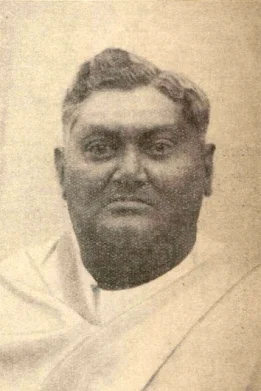 Dinendranath Tagore1882–1935Rabindranath's grand-nephew and the principal notator of his songs — the poet called him the keeper of all his songs. Taught music at Santiniketan.Photographer unknown, c. 1935 · Wikimedia Commons, public domain
 - Composition date
- 25 September 1926(৯ আশ্বিন ১৩৩৩)
English
Thou art a glimmer of gold from the dawn on my life's shore,
A dew-drop on the first white flower of autumn.
Thou art a rainbow from the distant sky
Bending o'er the dust,
A dream of the crescent moon
Touched with a white cloud,
Thou art a secret of paradise
Revealed by chance to the earth.
Thou art my poet's vision,
Appearing from the days
Of my forgotten birth,
Thou art the word that is never for utterance,
A freedom that comes in the form of a bondage,
For thou openest the door for me
To the beauty of a living light.
Translated by Rabindranath Tagore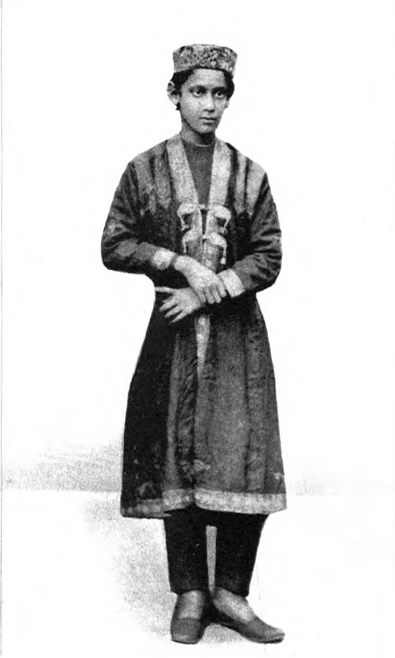 Rabindranath Tagore1861–1941Poet, composer and painter; the words and the melodies of every song in Gitabitan are his. Nobel laureate in Literature, 1913.His first photograph, Calcutta · 1873 ? · 25 Portraits of Rabindranath Tagore (Visva-Bharati, Calcutta, 1951)
AI translations
Machine-generated — may miss poetic nuance. Human translations above are authoritative.
Languages
Premium languages
AI-generated
Generating translation…
Couldn't generate a translation right now. Try again.